Key Protocol Takeaways
- Documented case studies confirm AI-assisted pages can rank #1 on Google, especially in low-competition or non-English niches.
- Semrush data shows human-written content holds #1 ~80% of the time vs 9% for pure AI, making raw AI #1 rankings rare but real.
- Over 64% of top SEO teams use a human-led, AI-assisted workflow—letting AI draft while human editors add experience, examples, and EEAT.
You've probably heard both sides. "AI content is dead on arrival." "AI content is basically the same as human content now." Neither one is the full picture, and the receipts (aka the actual case studies) tell a more interesting story.
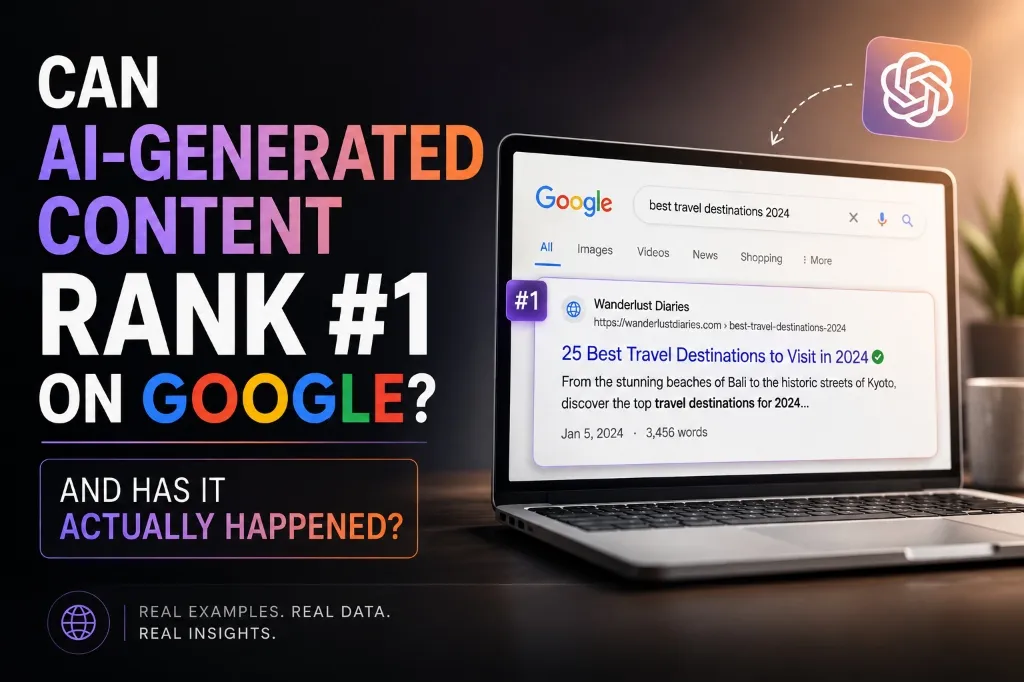
Short answer: yes, AI content can rank #1. It has happened, multiple times, across multiple industries. But it's not the default outcome — it's the exception that follows a pattern. Let's break down the real numbers instead of vibes.
1. What Google Actually Says (No Cap)
Google has been saying the same thing since 2023: it does not care who or what wrote your content. It cares if the content is good.
"Our systems focus on the quality of content, rather than how content is produced." — Google Search Central
That guidance hasn't changed — Google reaffirmed it again in 2025, and it still holds in 2026. Google's spam policies go after "scaled content abuse," which just means mass-produced, low-effort pages. That rule applies whether a human or a bot typed the words.
So the myth that Google auto-penalizes AI content isn't true. But that doesn't mean AI content wins by default either. Here's where it gets real.
2. The Case Studies: Where AI Content Actually Won
1. The Norwegian health site that hit 4,000 visitors a month
A health website built entirely on AI-written blog posts grew to 4,000 monthly visitors within weeks, according to case studies compiled by content platform Arvow. The trick wasn't just "generate and publish." The site targeted a low-competition market (Norwegian-language health content, where there simply isn't much competition) and stayed consistent with publishing.
2. The French site that went from 2,000 to 24,000 monthly visits
Same Arvow dataset, different market: a French-language website scaled from 2,000 to 24,000 monthly visits in six months using AI-assisted content. A separate video-to-blog strategy aimed at French speakers pulled in 5,400 monthly visits with minimal manual effort.
3. The 137-to-981 indexed pages jump
One Arvow user scaled their indexed pages from 137 to 981, and that expansion directly tracked with a rise in clicks and impressions. Across all 26 case studies in that dataset, spanning SaaS, ecommerce, fintech, and local business sites, the pattern held: AI content that's keyword-targeted, technically clean, and published on a schedule performed as well as or better than manual content, for way less time and money.
4. The keyword that got deindexed, then reindexed in the top 10
Not every story is a win. Rankability tested AI-generated content for the keyword "SEO training Houston." The page scored as 100% AI-written using their detector, and after a Google spam update, it got removed from the index entirely. Fair outcome, honestly — it was thin, low-effort content. The team then rewrote it with real human editing and added actual expertise. It got reindexed within hours and now sits in the top 10. Same topic, same keyword, completely different result once a human actually improved it.
5. The 6-out-of-20 rule
A separate analysis by Undetectable.ai looked at 20 different #1-ranking pages across competitive search terms and ran them through an AI detector. Six of those twenty #1 results scored above 50% AI-generated. That's not "AI never wins," and it's not "AI always wins" either — it's roughly a 30% hit rate for AI-flagged content sitting at the very top spot for genuinely competitive keywords.
3. Now the Reality Check: The Big Semrush Study
Here's the number that keeps the hype in check. Semrush analyzed 42,000 blog posts and 20,000 keywords, classifying every top-10 result with an AI detector.
Human-Written #1 Spots
Human-written content held the #1 spot 80% of the time, making human content ~8x more likely to grab #1 specifically.
Pure AI-Generated #1 Spots
Purely AI content held #1 only 9% of the time, though AI content frequently appeared in positions 2 through 4 on Page 1.
Put those two data sets side by side and you get the real answer: AI content ranking is common. AI content taking the #1 spot is rare but real, and it usually happens because a human touched it before it went live.
4. So What's the Actual Formula?
Research from Addlly found that 86.5% of top-ranking pages already contain some AI-generated content, but only about 10% of true #1 spots are fully AI without human editing. Meanwhile, 64% of SEO teams now run a human-led, AI-assisted workflow — meaning AI drafts it, a person fixes it up. And 72% of SEO pros say AI-assisted content performs as well as or better than fully human content once it's edited properly.
"The winning move isn't 'let the AI write it and hit publish.' It's 'let AI do the heavy lifting on structure and speed, then have a real person add experience, examples, and judgment.'"
5. The Bottom Line
AI content ranking #1 on Google isn't a myth, and it isn't a guarantee either. It's a real outcome that happens most often in lower-competition niches, non-English markets, or when AI drafts get real human editing before they go live. If you're chasing that top spot on a genuinely competitive keyword, the data says: don't skip the human pass. It's still, low-key, the difference-maker.
6. Sources
- Google Search Central: Google Search's guidance about AI-generated content
- Search Engine Land: Human content is 8x more likely than AI to rank #1 on Google (Study)
- Arvow: Does AI Content Rank on Google? 26 Case Studies and the Data (2026)
- Addlly: Can AI Content Rank On Google? The 2026 Data
- Rankability: Does Google Penalize AI Content? SEO Study (2026)
- Undetectable.ai: Does AI Content Rank in Google? Real Case Studies
7. Frequently Asked Questions
Has AI-generated content ever actually ranked #1 on Google?
Does Google penalize content just because AI wrote it?
Is fully AI-written content more or less likely to rank than human content?
What's the biggest factor that helps AI content actually rank?
Can AI content get deindexed by Google?
Does AI content work better in certain niches or languages?
What's the realistic workflow SEO teams are using with AI right now?
Topics & Tags

Rishabh Kumar
Author ProfileFounder & AI Product Strategist
7+ years building digital products, AI workflows, and human optimization systems for 20+ global clients including Google, Samsung, and Microsoft.