Key Protocol Takeaways
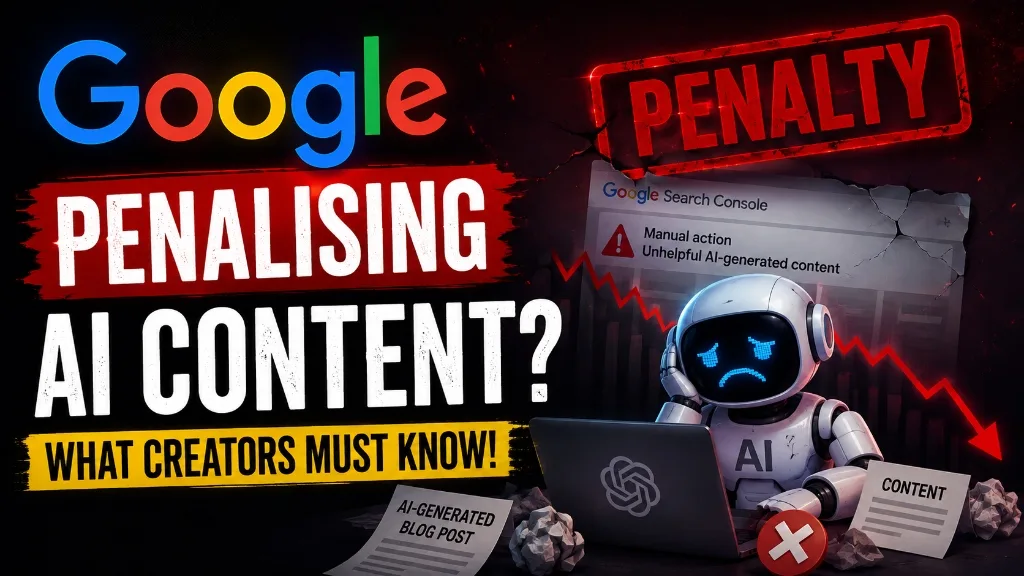
- Google's ranking systems reward E-E-A-T and content quality regardless of whether it is produced by humans or AI tools.
- Mass-produced, low-effort AI content created primarily to manipulate search rankings violates Google's spam policies (SpamBrain).
- Independent data shows over 80% of top-ranking search results combine AI efficiency with human editorial judgment and firsthand expertise.
If you've spent any time in SEO forums over the past two years, you've seen the panic. Someone publishes AI-assisted content, rankings dip a little, and the assumption jumps straight to "Google penalized me for using AI." The reality is messier and, honestly, more useful to understand than the panic suggests.
Google has published its position directly. Independent researchers have tested it against real search results. And thousands of site owners have asked the same question in Google's own support forums. Put those three things together, and a much clearer picture emerges than the one floating around on social media.
1. Google's Official Position, In Its Own Words
In February 2023, Google published a landmark post titled "Google Search's guidance about AI-generated content," and it remains the most direct statement Google has made on this topic. The core argument: Google's ranking systems aim to reward original, high-quality content that demonstrates E-E-A-T (Expertise, Experience, Authoritativeness, and Trustworthiness), and the company's focus has always been on content quality rather than how that content gets produced.
"Google's ranking systems aim to reward original, high-quality content that demonstrates E-E-A-T... Our focus is on the quality of content, rather than how content is produced." — Official Google Search Central Guidance
Google backs this up with a comparison worth sitting with. Around a decade ago, mass-produced but entirely human-written content became a real problem for search quality. Google didn't respond by banning human-written content outright; it improved its systems to reward quality content instead. The implication is direct: the same logic applies to AI. The tool isn't the target. The quality bar is.
That said, Google draws a clear line on intent. Using automation, including AI, to generate content primarily to manipulate search rankings violates Google's spam policies, and this guidance has stayed consistent for years, predating the current wave of AI tools. Google isn't naive about this either. The company has extensive experience dealing with automation used to game search results, and its spam-fighting systems, including SpamBrain, continue to operate regardless of how the spam gets produced.
2. What "Manipulating Rankings" Actually Means
This is where most of the confusion lives. People read "using AI to manipulate rankings is a violation" and assume that covers any AI-assisted content. It doesn't.
Google draws a distinction between content created to serve a reader and content created to game a ranking signal:
✓ Allowed & Rewarded
A recipe blog using AI to draft a post about weeknight dinners, then editing it, fact-checking it, and adding real cooking experience and photos.
✗ Spam Policy Violation
A site spinning out 500 near-identical AI articles targeting long-tail keywords with zero editorial oversight, factual verification, or original insight.
Google has also been clear that automation itself isn't the enemy. Weather forecasts, sports scores, and automated financial transcripts have used generation scripts for years without any ranking penalty, because they serve a genuine purpose for the reader. The presence of automation was never the trigger. The absence of value was.
3. What Independent Data Actually Shows
Google's word is one thing. What actually happens in search results is another, and that's where independent research gets useful.
Rankability ran a study analyzing 487 top-ranking Google search results across competitive commercial keywords, scoring each page's content through an AI content detector. The result: 83% of these top-ranking pages read as human-written rather than raw AI-generated. That's a meaningful signal—though worth taking with the right amount of caution, since this was a directional study with a focused sample.
What makes this study more interesting than a single statistic is the field evidence behind it:
- Case Study 1: An agency published 100% unedited AI content for a competitive local keyword. After a major Google spam update, the page was deindexed. The team rewrote it with genuine human input and real local knowledge, and it was reindexed within hours, eventually ranking in the Top 10.
- Case Study 2: AI-generated content for a service-based keyword underperformed for months, and only started climbing after a human writer rebuilt it with real domain expertise behind it.
A separate, larger study from Ahrefs examined 600,000 ranking pages and came to a compatible conclusion. Roughly 82% of top-ranking content showed a mix of AI and human authorship, with only a small fraction landing at either extreme (purely raw AI or purely unassisted human). That mix, not a hard split, appears to be how most competitive content actually gets built today.
4. What Actually Gets Penalized
Strip away the AI angle for a second, and the pattern underneath it looks familiar to anyone who's followed SEO for years. The things that consistently get demoted or removed from search results are the same things that always have been:
- • Content produced at scale with no editorial review, regardless of whether a human or a model wrote the first draft.
- • Pages that restate widely available information without adding anything new, insightful, or unique.
- • Content stuffed with keywords rather than written around genuine reader intent.
- • Duplicate or near-duplicate pages built solely to capture multiple keyword variants.
- • Thin pages with no real depth, expertise, or evidence of firsthand knowledge.
AI tools make it faster to produce content that fits every item on that list. That's the actual risk—not that Google has some hidden AI-detection penalty, but that AI makes it easier to mass-produce exactly the kind of content Google has been fighting for over a decade.
5. What the Google Community Consensus Looks Like
Beyond the official blog post, Google's own Search Central support forums see this question asked constantly. The pattern in responses from Googlers and experienced community members lines up with official guidance: AI-assisted content isn't inherently risky, but content built primarily to rank rather than to help a reader is.
John Mueller, one of Google's most visible search advocates, has reinforced this publicly on multiple occasions, stating plainly that AI-generated content is fine as long as it's high-quality and genuinely useful. That's consistent with what Danny Sullivan (Google's Search Liaison) stated: the issue was never AI specifically, it was content written primarily for search engines instead of people.
6. How to Actually Use AI Content Without Risking Rankings
Given all of this evidence, the practical blueprint is clear:
- Start with the reader's actual need, not the keyword: Content built to answer a real question naturally avoids the thin, generic patterns that get flagged.
- Treat AI output as a draft, not a finished product: Human review, fact-checking, and added expertise are what separate content that ranks from content that quietly underperforms.
- Add something a generic AI response can't: Specific data, direct experience, a named example, or an edge case demonstrate real E-E-A-T.
- Don't chase publishing volume over depth: Google's Helpful Content System catches content built for scale rather than substance.
- Watch for the actual violation, not the tool: The specific line Google draws is intent to manipulate rankings.
7. Frequently Asked Questions
Does Google have a specific AI content penalty?
Can Google actually detect AI-written content?
Is 100% AI-generated content guaranteed to rank poorly?
What's the safest way to use AI tools for content?
Does editing AI content make it count as "human-written"?
Are AI content detectors reliable for checking content before publishing?
Did Google's position on AI content change over time?
Topics & Tags

Rishabh Kumar
Author ProfileFounder & AI Product Strategist
7+ years building digital products, AI workflows, and human optimization systems for 20+ global clients including Google, Samsung, and Microsoft.