Key Protocol Takeaways
- Full topical coverage makes sites 6.5x more likely to get cited by AI tools like ChatGPT, Gemini, and Google AI Overviews than scattered coverage.
- 80% of sources cited by LLMs don't even rank in Google's traditional top 100 results, pulling instead from clear, trustworthy, well-structured sources.
- Semrush AI Visibility Index reveals that 53.7% of industry categories are still wide open with multiple brands fighting for the top spot.
Short answer: yes, and it's kind of a bigger deal now than it was for regular Google search.
AI tools like ChatGPT, Gemini, and Google's AI Overviews don't just skim one page and call it a day. They're checking if you actually know your stuff across a whole topic, not just one lucky post. Let's get into the receipts.
1. Wait, What Even Is Topical Authority?
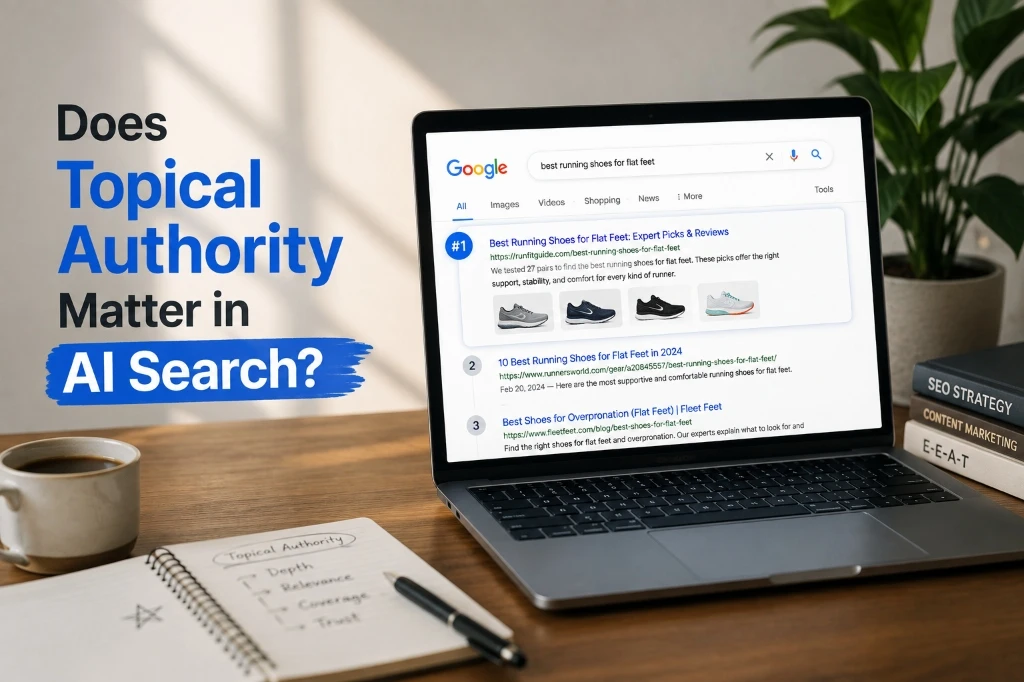
Topical authority just means: does your site cover a subject deeply, from every angle, or did you write one random article and hope for the best? A fitness site with 200 workout guides, recovery tips, and nutrition breakdowns has topical authority on fitness. A site with one "best protein powder" post does not, even if that one post is well written.
AI search engines care about this more than old-school Google did, because they're not just ranking pages, they're picking a small handful of sources to actually quote and summarize for the user. That means the bar is higher.
2. The Numbers That Prove It Matters
1. Full topical coverage = 6.5x more citations
A 2026 AI Visibility Audit found that sites with full, deep coverage of a topic were 6.5 times more likely to get cited by AI tools than sites with scattered, thin coverage of the same subject. That's not a small edge, that's basically the whole game.
2. Ranking #1 doesn't guarantee you get cited, but it helps a lot
The same research found sites ranking #1 on Google had a 58% chance of also getting cited in an AI answer. Sites sitting at position 10 had only a 14% chance. So being the best answer still counts for something, it's just not the only thing that counts anymore.
3. 80% of AI citations skip Google's top 100 entirely
Research from 79 Development found that a huge chunk, 80%, of sources cited by LLMs don't even rank in Google's top 100 results for that query. That sounds wild, but it lines up with how these tools actually work: they're not restricted to "top 10 blue links," they're pulling from wherever they find a clear, trustworthy, well-structured answer, even if that page never ranked traditionally.
4. The overlap between AI citations and Google rankings is shrinking fast
Ahrefs and ALM Corp found that only 38% of pages cited in Google's AI Overviews also show up in the traditional top 10 results, down from 76% just seven months before. Translation: ranking well on regular Google used to be a solid proxy for getting picked by AI. That's becoming less true, fast.
5. Citations cluster hard on a small number of trusted domains
Roughly 40% to 55% of ChatGPT Search and Perplexity citations go to fewer than 1,000 domains total, according to Digital Applied's 2026 research. Reddit and LinkedIn are now among the most-cited sources across nearly every major AI platform, which tells you these systems trust places with ongoing, real, topic-specific activity over one-off blog posts.
3. The Category Land-Grab Is Still Wide Open (For Now)
Here's the part that should get you hyped instead of stressed. Semrush's AI Visibility Index, built from 126 million prompts across 22 industries in ChatGPT, Gemini, and AI Overviews, found that as of June 2026, only 15.2% of categories had a clear, dominant brand owning that space in AI answers. Over half, 53.7%, were still wide open with multiple brands fighting for the top spot, and more than half of the leaders that did exist could still be dethroned by a challenger with a stronger topical push.
Wide Open Categories
Over half of all industries have no dominant brand yet, leaving top AI search citation spots up for grabs.
Dominant Brand Categories
Only 15.2% of tracked niches are owned by a single brand in AI answers, meaning early movers can win big.
Basically: most industries have not been "won" yet in AI search. That's your window. It's giving early-mover energy, not "the game is already over."
4. So How Do You Actually Build It?
You don't need to publish 500 pages overnight. You need a plan that covers your topic the way a real expert would explain it to a friend, not the way a keyword tool tells you to.
- Go deep, not just wide: One pillar page plus a cluster of supporting articles that answer every real sub-question in your topic beats ten random unrelated posts every time.
- Write answer-first: LLMs are 28% to 40% more likely to cite content that puts a clear, direct answer near the top of the section instead of burying it under a long intro.
- Use real numbers: Content with original statistics or data sees 30% to 40% higher visibility in AI answers, because a specific number is way easier for a model to quote than a vague claim.
- Show up outside your own site too: Since AI platforms lean hard on Reddit, LinkedIn, and other high-trust community spaces, genuine participation there builds citation equity that your website alone can't.
- Stay fresh: Some platforms, like Perplexity, weight recent content noticeably more than Google traditionally did, so a topic hub that never gets updated starts losing ground.
5. The Bottom Line
Topical authority isn't just an SEO buzzword anymore, it's basically the entry ticket to showing up in AI search at all. The data is pretty clear: broad, deep coverage of a topic beats a single great page, and being the best single answer on Google doesn't automatically make you the source an AI picks to quote. If you're building for 2026 and beyond, think in topics and clusters, not keywords and one-off posts.
6. Sources
- Growth Memo: Does topical authority matter in AI Search?
- Cognerd: How to Build Topical Authority for AI Search Visibility
- 79 Development: The State of AI Search 2026
- Memeburn: Google AI Overview Statistics 2026
- Digital Applied: AI Search Engine Statistics 2026: Market Share Data
- Averi.ai: How to Get Featured in Google AI Overviews (2026 Playbook)
- Quantum Agency: AEO Optimization Across ChatGPT, Google & Perplexity
7. Frequently Asked Questions
Does topical authority actually matter for AI search, or is it just an SEO trend?
Do I need to rank #1 on Google to get cited by AI tools like ChatGPT or AI Overviews?
Can a page get cited by AI even if it never ranked well on Google?
Which platforms get cited the most by AI search tools right now?
Is it too late to build topical authority in my industry?
What's the fastest way to start building topical authority?
Does content freshness affect topical authority in AI search?
Topics & Tags
Rishabh Kumar
Author ProfileFounder & AI Product Strategist
7+ years building digital products, AI workflows, and human optimization systems for 20+ global clients including Google, Samsung, and Microsoft.