Key Takeaways
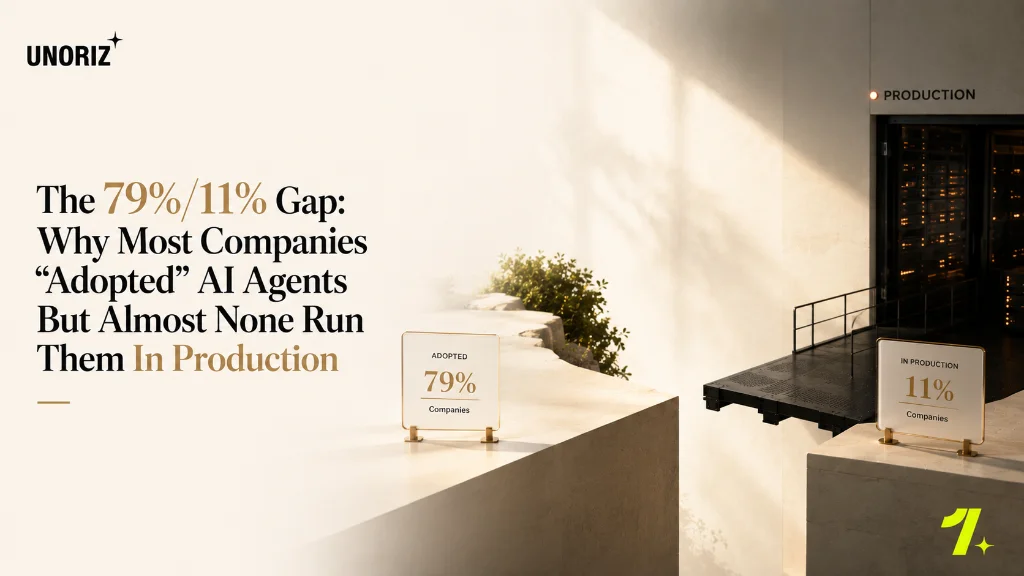
- The 79%/11% Chasm: 79% of organizations report adopting AI agents, but only 11% have autonomous workflows operating on live production systems without constant human babysitting.
- Infrastructure Over Models: The bottleneck isn't LLM reasoning capability—it is enterprise integration, security guardrails, authentication, rate limits, and unbudgeted middleware engineering.
- Governance & Accountable Ownership: 40% of organizations run agents with zero governance guardrails, and Gartner projects 40% of agentic projects will be cancelled by 2027 due to unclear ROI and unmitigated risk.
Everyone says they have AI agents now. Your LinkedIn feed is proof. But here's the plot twist: most of those agents never leave the demo stage.
New 2026 data puts a number on it. 79% of companies say they have adopted AI agents in some form. Only 11% actually run them in production, the stage where an agent works on real tasks, with real data, without a human babysitting every step (SaaSUltra, 2026). That's not a small gap. That's a chasm. And it's the most important stat in enterprise AI right now.
This article breaks down why the gap exists, who's actually closing it, and what it means if your company is stuck in “adopted but not really using it” mode.
While 79% of enterprises claim AI agent adoption, only 11% have transitioned autonomous agents into live production workflows that interact with real customers and operational databases without constant supervision.
1. What “Adopted” Actually Means (Spoiler: Not Much)
Here's the thing nobody tells you upfront. “Adopted” is a low bar. It can mean a team ran one pilot. It can mean a manager signed off on a $20-a-month tool. It can mean someone connected an agent to a sandbox environment and called it a win.
PwC found 79% of companies are adopting AI agents, and 88% of executives plan to raise AI budgets because of it (Panto AI, 2026). WRITER's research found 97% of executives say their company deployed an agent in the past year (Panto AI, 2026). Those numbers sound huge. They're also measuring intent and early activity, not agents doing real work at scale.
Production is a different animal. It means the agent touches live customer data, live transactions, or live decisions, and it keeps running without someone rewriting the prompt every other day. Different sources land in slightly different places here (11%, 31%, or 51% depending on how “production” gets defined), but every credible 2026 report agrees on one thing: it's a fraction of the adoption number, not close to it.
2. Why the Gap Is So Big
It's not the AI models. That part's lowkey solved. GPT and Claude-class models can already handle most of the reasoning agents need. The gap comes from everything around the model.
- Governance never got built: A report on stalled AI pilots found the real blockers are governance gaps, poor visibility into what agents are doing, and “shadow AI” that pops up before security teams even know it exists (WitnessAI, 2026). Only 60% of organizations have any AI governance policy at all, which means 40% are running agents with zero guardrails (WitnessAI, 2026).
- Integration is the real boss fight: A pilot connects to a mocked-up database. Production has to connect to your actual CRM, your actual ERP, and your actual customer records, with real authentication, rate limits, and the occasional system outage. That's a completely different level of engineering, and most pilots never budget for it (AnAr Solutions, 2026).
- Nobody owns it: Fewer than 1 in 5 companies assessed had a formal governance framework for how agents are allowed to behave (AnAr Solutions, 2026). Without a named owner and a clear success metric, a pilot just quietly dies when the person who championed it gets busy or leaves.
- The bar for trust is higher: Giving an agent power to actually act, like refunding a customer or editing a database, means a mistake isn't a bad chatbot reply anymore. It's real money or real risk. Companies slow down here on purpose, and honestly, they should.
4 out of 10 organizations currently experimenting with or deploying autonomous AI agents lack any formalized governance policies, introducing severe compliance, security, and financial risks.
3. The Industries Actually Getting It Right
Not every sector is stuck. Banking and insurance lead the pack, with around 47% of these companies running at least one agent in production. Healthcare and government trail behind at 18% and 14% (Digital Applied, 2026).
That split makes sense. Banks already have compliance teams, audit trails, and risk frameworks built for regulated work. Slotting an agent into that structure is less of a leap. Healthcare and government move slower because the stakes (patient safety, public trust) are higher and the systems are older.
Customer service is the standout use case across industries. It has the shortest payback period of any function, around 4 months, because the workflows are repeatable and the ROI is easy to measure (SaaSUltra, 2026). Marketing operations and engineering follow, each taking longer to pay back but still landing in positive territory for most deployments.
Customer service remains the fastest path to positive ROI for agentic deployments due to repeatable task structures, deterministic resolution metrics, and direct labor-cost leverage.
4. The Money Problem Nobody Talks About
Here's a stat that should make every CFO sit up: Gartner predicts 40% of agentic AI projects will get cancelled by the end of 2027, mostly because of high costs, unclear business value, or risk that wasn't managed properly (Prefactor, 2026).
That means companies aren't just failing to launch agents. Some are launching them, spending real money, and then pulling the plug. It's giving expensive science project, not competitive advantage.
The companies avoiding this outcome tend to do three things before they scale past a single pilot: they name one person who owns the agent's outcomes, they measure real business impact instead of vibes, and they build the governance layer before the second project starts, not after the first one breaks something (Digital Applied, 2026).
5. So What Should Your Company Actually Do
If your company is somewhere in that 79%, adopted but not producing, here's the honest checklist:
- Pick one workflow, not ten: Customer service or a single back-office task, not “transform the whole company.”
- Name an owner: A person, not a committee, who's accountable for whether the agent actually works.
- Build the guardrails first: Decide what the agent can and can't do on its own before you give it real access.
- Measure something real: Time saved, cost per task, tickets resolved. Not “the team likes it.”
- Plan for the boring parts: Authentication, rate limits, error handling. That's where 80% of pilots quietly die (AllCloud, 2026).
6. The Bottom Line
The AI agent hype cycle is real, but the 79%/11% gap tells the actual story. Almost everyone has tried an agent. Almost nobody has made one boring enough, reliable enough, and governed enough to trust with real work every single day.
That's not a reason to skip agents. It's a reason to slow down on the flex and speed up on the fundamentals. The companies that close this gap in the next year won't be the ones with the flashiest demo. They'll be the ones who treated governance and integration as seriously as the model itself.
7. References
- SaaSUltra: AI Agent Statistics 2026: Adoption Rates, ROI Data
- Panto AI: AI Agents Statistics 2026: Market Size & Adoption
- WitnessAI: Why AI Pilots Fail and How Yours Can Succeed
- AnAr Solutions: Why 88% of Agentic AI Pilots Never Reach Production
- Digital Applied: AI Agent Adoption 2026: 120+ Enterprise Data Points
- Prefactor: Agentic AI Adoption Statistics
- AllCloud: Why Your AI Pilot Never Reached Production and How to Fix It
8. FAQs
1. What does the 79%/11% gap actually mean?
2. Why do so many AI agent pilots fail to reach production?
3. Which industries are furthest ahead with AI agents in production?
4. Is it worth investing in AI agents if most pilots don't reach production?
5. What's the fastest AI agent use case to show ROI?
6. How many AI agent projects actually get cancelled?
7. What should a company do first before scaling AI agents company-wide?
Topics & Tags

Rishabh Kumar
Author & Lead ResearcherFounder & AI Product Strategist
7+ years building digital products, AI workflows, and human optimization systems for 20+ global clients including Google, Samsung, and Microsoft.