Key Protocol Takeaways
- Independent 2026 research puts real-world AI detector accuracy between 66% and 92%, far below vendor marketing claims of 99%+.
- Pangram emerged as the current top performer, achieving close to a zero false-positive rate (under 0.5%) and catching 97.5% of AI text in academic benchmarks.
- Detectors struggle most on hybrid/edited AI drafts and severely flag non-native English writers (up to 61.3% false-positive rate in Stanford research).
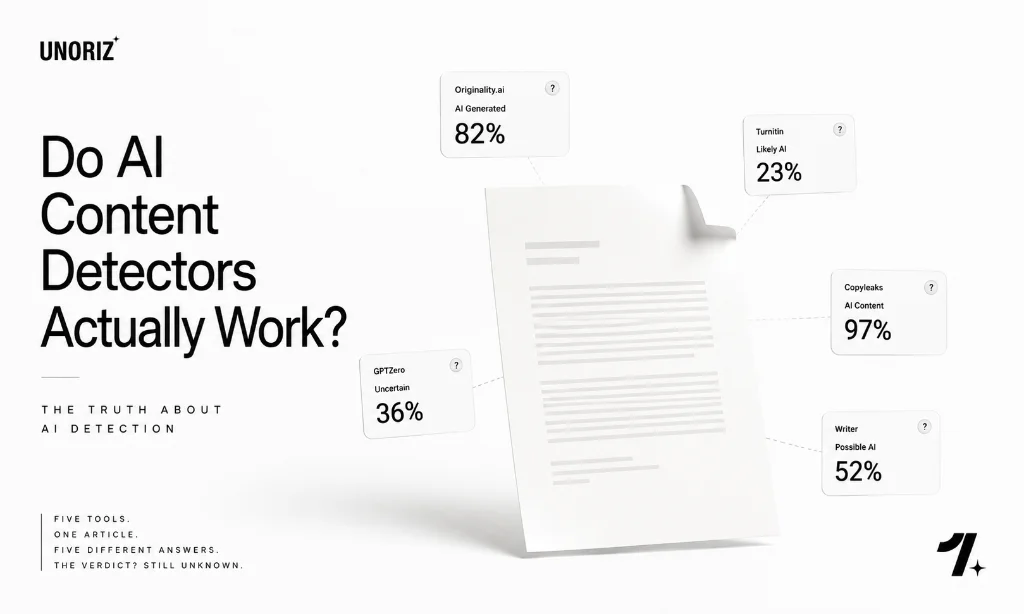
Run the same paragraph through two AI detectors and you can get two totally different verdicts. One says "98% human." The other says "94% AI." Same text, same day, zero changes. If you've ever done a content audit and watched Pangram and QuillBot disagree on the exact same article, you already know this isn't a hypothetical. It's the actual, messy reality of AI detection in 2026.
So let's answer the real question: do these tools work, or are we all just trusting a fancy guess?
1. The Short Answer
Some detectors work well. Most don't work as well as they claim. And the gap between marketing numbers and real-world numbers is bigger than most people think.
Vendors love to say "99% accurate." Pangram claims 99.85%. GPTZero claims 99.76%. Originality.ai claims 99%. Copyleaks claims 99.12%. But independent researchers who actually test these tools against real writing—not the vendor's own cherry-picked dataset—keep landing on a very different number: real-world accuracy somewhere between 66% and 92%, depending on the tool and the type of text.
Marketing vs. Reality Gap
That's a huge range. It's the difference between a tool you can rely on for content governance and a coin flip with extra steps.
2. The Numbers That Actually Matter
1. Detector disagreement is normal, not rare
A 2026 peer-reviewed study out of Vrije Universiteit Brussel tested four major detectors—Pangram, GPTZero, Turnitin, and Copyleaks—on 160 long academic papers split between human, AI, hybrid, and "humanized" AI writing. Only one tool, Pangram, produced results the researchers called satisfactory. The other three struggled, especially on hybrid text where a human edited an AI draft. That's the exact situation most real content teams live in daily.
2. QuillBot is popular but shaky
Independent journalist testing puts QuillBot's AI detector around 80% accuracy, noticeably behind GPTZero's claimed 99.5% and Scribbr's 84% in the same comparison.
Separate 2026 testing found QuillBot flags real AI content correctly about 71% of the time, but incorrectly flags 13% of genuinely human-written content as AI. In one hands-on humanizer test, QuillBot's detection score dropped straight to 0% after a single round of "humanizing," making it the easiest of eight tested tools to fool.
3. Pangram is the current outlier (in a good way)
Independent University of Chicago Booth research found Pangram had close to a zero false-positive rate across passage lengths, the only tool in that study meeting a strict 0.5% policy threshold without losing its ability to catch real AI text.
In the Brussels academic study, Pangram caught 97.5% of fully AI-written papers and 95% of humanized ones, well ahead of the other three tools tested.
4. Turnitin's real-world numbers don't match its marketing
Turnitin advertises a false-positive rate under 1%. Independent classroom analysis puts the real number closer to 5% to 20%, and specifically higher for non-native English writers. Vanderbilt University actually disabled Turnitin's AI detector in 2023 after calculating that even the vendor's own "1%" claim would wrongly flag around 750 real student papers a year.
5. Non-native English writers get hit hardest
A widely cited Stanford study found detectors had a 61.3% average false-positive rate on essays written by non-native English speakers, and all seven detectors tested in that study unanimously misclassified nearly 20% of TOEFL essays. This is the single biggest fairness problem in AI detection right now, and it's still not fully solved in 2026.
6. Humanizing tools genuinely break most detectors
A 2026 hands-on test running the same AI-generated passage through eight detectors, before and after "humanizing" it, found that no detector stayed reliable after repeated humanization rounds. Pangram and Originality.ai held up best on a single pass. Everything else, including QuillBot, lost the plot fast.
3. Why Do Detectors Disagree So Much?
Most detectors work by measuring two core statistical metrics:
Measures how predictable word choices are. AI text tends to choose statistically high-probability words, creating low perplexity.
Measures how much sentence length and rhythm vary. Human writing is naturally uneven and varied, while AI text is smooth and uniform.
The problem is that heavily edited AI content, or AI-assisted content with real human input layered on top, breaks that pattern. It's neither purely "smooth AI" nor purely "messy human." It sits in the middle, and different detectors are tuned to guess that middle zone completely differently. That's exactly why one tool might call your article 90% human while another calls it 60% AI, even though nothing about the text changed between checks.
4. So Should You Trust Them At All?
Kind of, but not blindly. The consistent advice across every serious 2026 study is the same: use detectors as one signal, not the final verdict. No cap, a single detector score should never be the reason someone loses a grade, a job, or a byline.
The smartest editorial and governance workflow right now looks like this:
- Multi-detector testing: Run text through two detectors that use different underlying algorithms and detection methodologies.
- Look for agreement: Focus on consensus between models rather than blindly trusting a single percentage output.
- Prioritize human judgment: Always leave room for editorial review and subject matter expert verification on anything flagged as borderline.
If you're auditing content at scale, whether that's academic papers or a giant catalog of articles, treat detector disagreement as expected, not broken. It's giving "still early days" energy across the whole industry, and the tools that acknowledge that limitation tend to be the more trustworthy ones.
5. The Bottom Line
AI content detectors are real and some are genuinely useful, but "accurate" depends entirely on which tool, which dataset, and which kind of writer you're testing. The vendor number on the homepage is rarely the number you'll see in practice. If two detectors ever disagree on the same piece of text in front of you, that's not a bug in your process—that's just what AI detection looks like right now.
6. Sources
- Arvow: AI Content Detector Report 2026: 70+ Sourced Stats
- Pangram Labs: Third-Party Pangram Evaluations
- GradPilot: AI Detector False Positive Rates Compared (2026)
- CiteDash: AI Detection Tools Accuracy: An Honest 2026 Review
- Textero: QuillBot AI Checker Review: Accuracy Tests & Results (2026)
- Medium: Best AI Detector in 2026? I Tested 8 Detectors Against an AI Humanizer
- Originality.AI: AI Detection Accuracy Studies — Meta-Analysis of 15 Studies
7. Frequently Asked Questions
Are AI content detectors actually accurate?
Why do Pangram and QuillBot give different results on the same text?
Can AI detectors be fooled by "humanizer" tools?
Do AI detectors falsely flag human writing as AI-generated?
Which AI detector is considered most reliable in 2026?
Should I trust a single AI detector score to prove content is AI-written?
Why do non-native English speakers get flagged more often by AI detectors?
Topics & Tags

Rishabh Kumar
Author ProfileFounder & AI Product Strategist
7+ years building digital products, AI workflows, and human optimization systems for 20+ global clients including Google, Samsung, and Microsoft.