Key Takeaways
- Sleep regularity (consistent bedtime and wake time) is a stronger predictor of mortality risk than sleep duration itself, according to studies in SLEEP.
- Irregular sleepers face a 20% to 88% higher all-cause mortality risk and a 26% to 53% higher dementia risk, independent of how long or well they sleep.
- Melatonin reduces sleep latency by only ~7 minutes on average in major meta-analyses, treating bedtime symptoms rather than root circadian disruption.
You probably know someone with a nightstand full of melatonin gummies, magnesium powder, and some fancy sleep drink that costs more than dinner. Meanwhile, they go to bed at 10pm on Tuesday and 3am on Friday. That combo is backwards, and the research on this is honestly not close.
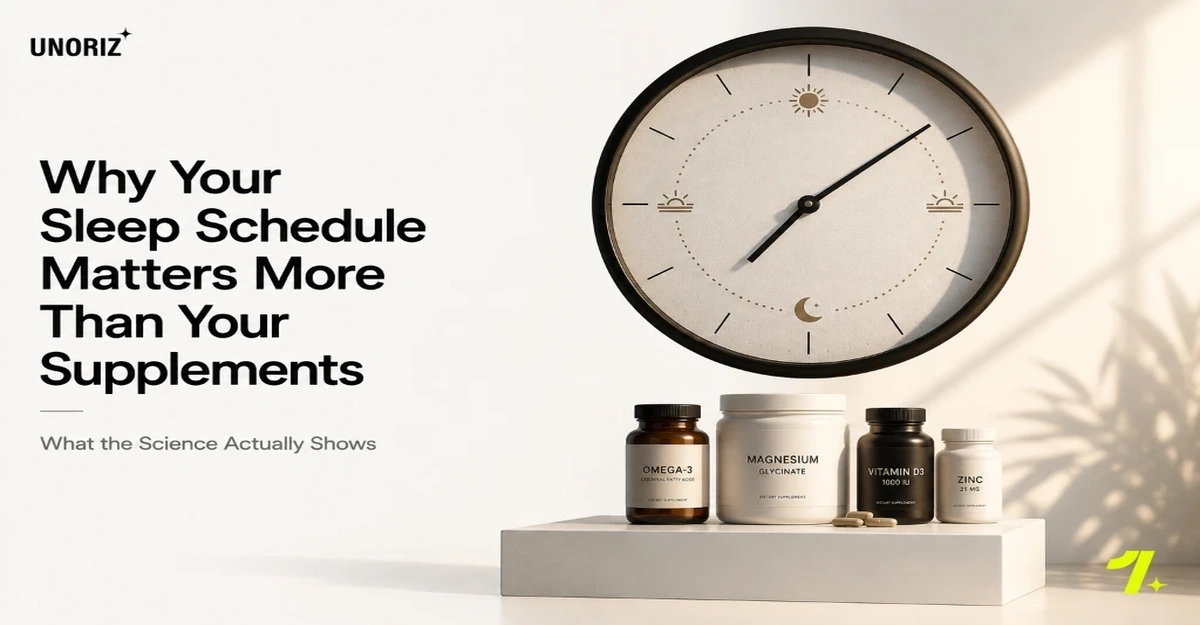
Going to bed and waking up at roughly the same time every day matters more for your health than almost any sleep supplement you can buy. Not a little more. In some studies, a lot more.
1. The Study That Changes the Conversation
For years, sleep advice mostly focused on one number: how many hours you get. Seven to nine hours, right? That's the number everyone repeats. But a large 2025 systematic review pulling together 59 studies found something that should get more attention than it does: it's not just how long you sleep, it's how consistent your sleep timing is, night after night.
The Sleep Regularity Index (SRI)
The review analyzed the Sleep Regularity Index—a score measuring how similar your bedtime and wake time are from day to day. People with low regularity (bouncing sleep schedules) showed higher rates of depression, anxiety, BMI, insulin resistance, high blood pressure, and cardiovascular events.
26% to 53% Higher Dementia Risk
Prospective biobank data linked irregular sleep directly to smaller hippocampal volume (the brain region tied to memory) and a 26% to 53% higher risk of dementia.
20% to 88% Higher All-Cause Mortality Risk
Five separate long-term studies found irregular sleepers had 20% to 88% higher all-cause mortality, and this held up even after accounting for total sleep duration and sleep quality. In plain English: two people can sleep the exact same number of hours, and the one with the messier schedule still faces meaningfully higher health risks.
"A 2024 study in the journal SLEEP found sleep regularity was a stronger predictor of mortality risk than sleep duration itself. Not equal. Stronger."
2. So What About Supplements?
Here's where it gets real. Melatonin is the most popular sleep supplement on earth, and it does work—just not in the dramatic way marketing suggests.
A major meta-analysis of 19 studies (1,600+ participants) found melatonin reduced time to fall asleep by ~7 minutes compared to placebo.
The same meta-analysis showed melatonin added roughly 8 minutes to total sleep duration over a full night.
Compare those numbers. A 7-minute faster fall-asleep time versus an 88% difference in mortality risk tied to schedule consistency. That's not really a fair fight, and it gives major perspective on where your energy (and money) should actually go.
3. Why Timing Hits Harder Than a Pill
Your body runs on a circadian rhythm—an internal clock governing hormone release, body temperature, digestion, and sleep. When your bedtime swings around constantly, your body experiences a mini version of jet lag every few days, even if you never leave your time zone. Researchers call this social jetlag, and it's linked to systemic inflammation and metabolic issues.
Melatonin can nudge your body toward sleep on a given night. But it can't undo the deeper disruption of a schedule that never holds still. It's treating a symptom, not the root cause.
4. What Actually Helps (Backed by Research)
- Fixed bedtime & wake time: Pick a schedule you can hit most days, weekends included, to eliminate social jetlag.
- Prioritize consistency over length: A slightly shorter but steady schedule beats out irregular 9-hour sleep binges in health outcomes.
- Treat melatonin as a nudge: If using melatonin, take low doses (0.5mg–3mg) 30 minutes to 2 hours before bed as a timing signal, not a knock-out pill.
- Track sleep regularity: Use wearables to measure your Sleep Regularity Index (SRI) as an objective, modifiable daily target.
5. The Bottom Line
Supplements are not useless. Melatonin genuinely helps some people fall asleep faster. But if you're serious about long-term health, brain function, and metabolism, the schedule you keep matters far more than what's in your supplement drawer. Fixing your bedtime consistency is free, backed by stronger evidence than almost any pill, and is the single change shown to move the needle on dementia risk and mortality.
6. Sources
- PubMed: Sleep regularity as an important component of sleep hygiene: a systematic review (2025)
- SLEEP (Oxford Academic): Sleep regularity is a stronger predictor of mortality risk than sleep duration (2024)
- SLEEP (Oxford Academic): Time to regularize sleep regularity commentary (2026)
- PLOS One: Meta-Analysis: Melatonin for the Treatment of Primary Sleep Disorders
- Journal of Pineal Research: Optimizing the Time and Dose of Melatonin as a Sleep-Promoting Drug
- PMC: Systematic Review & Network Meta-Analysis of RCTs Evaluating Melatonin, Light Exposure, and CAM for Insomnia
7. Frequently Asked Questions
Is sleep schedule consistency really more important than how many hours I sleep?
Does melatonin actually work for sleep?
What is social jetlag and why does it matter?
Can an irregular sleep schedule really increase dementia risk?
Should I stop taking sleep supplements?
How much does an inconsistent sleep schedule affect mortality risk?
What's the easiest way to start improving sleep regularity?
Topics & Tags

Rishabh Kumar
Author & Lead ResearcherFounder & AI Product Strategist
7+ years building digital products, AI workflows, and human optimization systems for 20+ global clients including Google, Samsung, and Microsoft.