Key Takeaways
- The Checkbox Equivalence Fallacy: Standard task managers assign equal visual weight to a 10-minute administrative errand and an 8-hour engineering deliverable, hiding the true hourly commitment until the day is already overbooked.
- Kahneman-Tversky Planning Bias: Without an explicit daily capacity ceiling (such as 8h or 9h of working capacity minus calendar meetings), teams systematically overcommit daily schedules by 40% to 70%.
- Workload Smoothing Over Rollover Debt: Distributing multi-day tasks evenly across working days and tracking effort-weighted consistency prevents the demoralizing end-of-day task rollover cascade.
Open almost any modern task manager on a Monday morning and you will see the same structural defect: a vertical stack of 14 checkboxes scheduled for “Today.” Item one is a 15-minute vendor invoice approval. Item two is a 5-hour database migration. Item three is a 3-hour product strategy deck.
On screen, those three tasks occupy the exact same 40 pixels of vertical height. In reality, they represent 8.25 hours of focused cognitive labor — before accounting for a single calendar meeting. By 6:00 PM, half the list remains unfinished, rolling over into Tuesday and compounding into a permanent backlog that erodes execution trust.
1. The Checkbox Equivalence Illusion
The fundamental unit of human execution is not the checkbox; it is time-bounded cognitive capacity. When a planning tool stores tasks without an effort denominator (hours or work units) and without a daily capacity numerator (available working hours), it encourages infinite list accumulation.
In cognitive psychology, uncompleted tasks that lack a realistic execution window trigger two compounding penalties: attention residue when switching between overloaded priorities (Leroy, Organizational Behavior and Human Decision Processes) and Zeigarnik intrusive rehearsal when unfinished items spill into evening recovery hours.
Empirical productivity audits across knowledge workers reveal that roughly 41% of items added to uncalibrated checkbox lists are indefinitely postponed or abandoned due to lack of capacity accounting at the moment of scheduling.
2. The Mathematics of the Planning Fallacy & Meeting Tax
First formalized by Daniel Kahneman and Amos Tversky in 1979, the Planning Fallacy describes our systematic tendency to estimate task completion based on an idealized best-case scenario while ignoring base-rate interruptions. In modern organizations, the single largest hidden deduction from daily capacity is the calendar meeting tax.
If an operator has a 9-hour workday (09:00 to 18:00) and 3.5 hours of scheduled Google Calendar meetings, their true remaining execution capacity is 5.5 hours — not 9 hours. A task list that stays disconnected from live calendar events tricks the operator into planning a 9-hour task load inside a 5.5-hour window, guaranteeing a 163% overload before the day even begins.
3. How Capacity-Bounded Execution Works in Practice
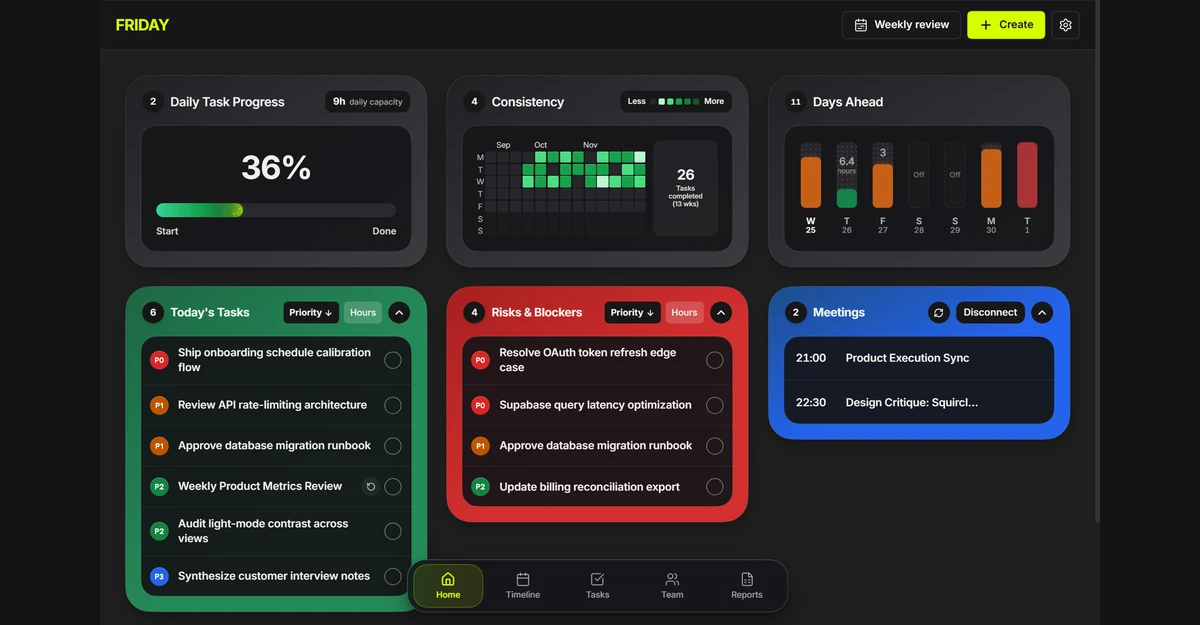
When we architected Friday OS at Unoriz, we replaced the uncalibrated list model with a deterministic workload engine built around three rules:
-
Multi-Day Workload Distribution: If a 12-hour engineering task spans Monday through Wednesday across a standard working schedule, the capacity engine automatically allocates
4.0h/dayacross those three working days rather than dumping a single opaque checkbox on Wednesday's deadline. - Rolling 7-Day Capacity Telemetry (Days Ahead): Every day in the 7-day planning horizon displays its exact committed hours against daily working capacity, flagging overbooked days in real time so tasks can be re-leveled proactively.
- Explicit Risks & Blockers Triage: Rather than letting stalled tasks silently pollute the active execution queue, blocked items are elevated into a dedicated risk telemetry surface until unblocked.
Research by Gerald Weinberg and Gloria Mark demonstrates that each unscheduled task switch consumes roughly 20% of available cognitive throughput in re-orientation overhead. Capping daily work to 100% of true hourly capacity preserves contiguous deep-work blocks.
4. Effort-Weighted Consistency vs. Streak Gamification
Consumer habit apps rely on fragile binary streaks that punish users for taking a scheduled weekend off or reward them equally for checking off a 2-minute trivial item. In serious execution systems, consistency should reflect completed workload hours relative to your configured working schedule across a rolling 13-week quarterly window — respecting non-working recovery days while making sustained deep output visible at a glance.
Tracking completed workload intensity across a rolling 91-day quarterly matrix aligns individual daily capacity with quarterly business deliverables without punitive weekend streak resets.
5. References
- Kahneman & Tversky (TIMS Studies in the Management Sciences): Intuitive Prediction: Biases and Corrective Procedures (The Planning Fallacy)
- Organizational Behavior and Human Decision Processes (Sophie Leroy): Why Is It So Hard to Do My Work? The Challenge of Attention Residue When Switching Between Work Tasks
- UC Irvine Informatics (Dr. Gloria Mark): The Cost of Interrupted Work: More Speed and Stress
- Unoriz Engineering Case Study: Building Friday OS: Workload & Capacity Engine Architecture
6. FAQs
1. How is capacity-based planning different from rigid calendar time-blocking?
2. How does a capacity planner handle multi-day projects?
3. What is attention residue and why does overbooking trigger it?
4. How much buffer capacity should teams leave in a daily schedule?
5. Where can I test a capacity-based planner live?
Topics & tags

Rishabh Kumar
Author & Lead ResearcherFounder & AI Product Strategist
7+ years building digital products, AI workflows, and human optimization systems for 20+ global clients including Google, Samsung, and Microsoft.