Key Takeaways
- Ahrefs data across 300,000 keywords reveals that Google AI Overviews cause an average 58% drop in organic click-through rates for position 1 rankings.
- A randomized controlled experiment proved causality: removing AI Overviews from search result tops nearly doubled outbound clicks to publishers.
- While organic CTR declines, users who click through AI Overviews convert 23% better, and cited brands earn 35% more organic clicks and 91% more paid clicks.
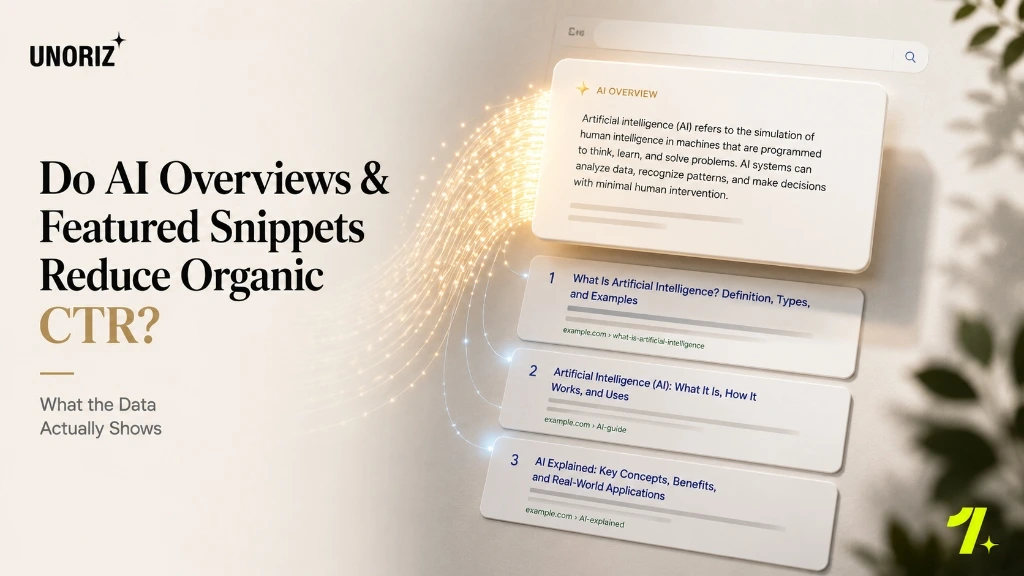
Yes, and it's not a small dip. It's one of the biggest single-feature hits to organic clicks Google has ever rolled out. If your traffic has felt off lately even though your rankings look fine, this is probably why.
This is a different problem than “does AI content rank.” Your page can hold position 1 and still get way fewer clicks than it used to, simply because Google answered the question before anyone reached your link. Let's get into the real numbers.
1. The Headline Stat
Ahrefs ran the most rigorous version of this study using 300,000 keywords, split evenly between queries with an AI Overview present and similar informational queries without one. As of December 2025, they found the presence of an AI Overview correlates with a 58% lower average click-through rate for the page ranking in position 1.
That's not a one-off finding either. Multiple independent studies landed in the same range. Seer Interactive, tracking over 3,100 queries and 42 organizations, found organic CTR dropped 61%, falling from 1.76% down to 0.61% when AI Overviews appeared. Other researchers found similar territory, with drops ranging from 47.5% to over 50%, and some outlets reporting numbers as high as 80–90% for specific query types.
So depending on exactly who measured it and how, you're looking at roughly half to two-thirds of your expected clicks disappearing the moment an AI Overview shows up above your result.
Ahrefs 300k-keyword analysis proved pages holding #1 rank lose over half their organic click-through volume when an AI Overview displays.
Removing AI Overviews in controlled testing nearly doubled user click-throughs to publisher websites, isolating direct causality.
2. It Gets Worse the Higher You Rank
Here's the part that stings a little extra if you've been chasing position 1 this whole time. Ahrefs broke the impact down by ranking position, and the pattern is brutal for anyone at the top.
Position 1 saw a 58.0% CTR drop. Position 2 saw 50.8%. It keeps sliding down from there, all the way to position 10 at 19.4%. In other words, the page working hardest to rank #1 loses the most clicks proportionally. Being the “best answer” used to guarantee the most traffic. Now it mostly guarantees your content gets summarized instead of visited.
Position 1: -58.0% | Position 2: -50.8% | Position 3: -41.2% | Position 5: -32.5% | Position 10: -19.4%
3. This Isn't Just Correlation Anymore
For a while, skeptics could say “maybe this is just correlation, maybe AI Overviews show up more on queries that were already low-click.” A newer study fixed that problem directly.
Researchers ran a randomized experiment, meaning they controlled who saw an AI Overview and who didn't, isolating cause and effect instead of just spotting a pattern. Removing the AI Overview from the top of the page nearly doubled outbound clicks. The researchers stated plainly that AI Overviews divert traffic away from publishers without delivering measurable improvements in user experience.
Pew Research backed this up with real-world behavior data. Users click through only 8% of the time when an AI Overview is present, compared to 15% without one, roughly a 47% relative drop in click behavior.
4. The Bigger Picture: Zero-Click Is Just... Normal Now
AI Overviews are part of a much bigger shift. The overall zero-click rate, meaning searches that end without any click at all, has climbed from around 50% in 2019 to nearly 65% in 2026. That trend started before AI Overviews even existed, thanks to featured snippets and knowledge panels, but AI Overviews accelerated it hard. In AI Mode specifically, where Google replaces search results entirely with a conversational interface, the zero-click rate hits roughly 93%.
Organic click share overall dropped 11 to 23 percentage points across multiple industries between January 2025 and January 2026, while paid ad clicks gained ground in the same window. It's giving one clear trend: the traditional “rank high, get clicks” model is quietly breaking down.
Up from ~50% in 2019, driven by featured snippets, quick knowledge cards, and expanded AI synthesis boxes.
Conversational search interfaces satisfy user queries natively within the interface, cutting traditional outbound browsing.
5. It's Not All Doom Though
Here's the twist that actually matters for strategy. The clicks that do survive an AI Overview convert better. One analysis found AI Overviews reduce organic CTR by an average of 18%, but the users who still click through convert 23% better, since they've already read a summary and are seeking something deeper.
Separately, brands that get cited inside AI Overviews earn 35% more organic clicks and 91% more paid clicks compared to brands on the same query that don't get cited at all.
So the smarter framing isn't “traffic is dying.” It's “traffic is getting smaller, more intentional, and increasingly gated behind whether you get cited in the first place.”
6. What Actually Helps Right Now
1. Optimize for Citations Inside AI Overviews
Stop optimizing purely for position 1 and start optimizing for citation inside the AI Overview itself, since that's now the bigger prize.
2. Structure Front-Loaded Direct Answers
Structure content with clear, direct answers near the top of each section, since that's the format AI Overviews pull from most easily.
3. Track Citations as a Core KPI
Track citations, not just rankings, using tools built for this. Ranking well without getting cited is quickly becoming a hollow win.
4. Focus on High-Intent & Transactional Depth
Focus extra effort on content that still earns real clicks even with an AI Overview present, typically deeper, comparison, or transactional content rather than simple factual queries.
5. Segment Branded vs Non-Branded Tracking
Watch branded versus non-branded query performance separately, since the CTR hit tends to vary noticeably between the two.
7. The Bottom Line
AI Overviews and featured snippets are cutting organic click-through rates by roughly half in most recent studies, and the highest-ranking pages are losing the most, proportionally. This isn't a temporary glitch, it's a structural shift in how search works, backed now by both large-scale data and a real randomized experiment.
The traffic isn't gone forever, though. It's shifting toward citation-based visibility, and the brands adapting to that shift early are the ones still seeing real clicks come through.
8. Sources
- Ahrefs: Google AI Overviews Reduce Organic CTR by 58%
- Search Engine Journal: Study Confirms Google AI Overviews Cut Organic Clicks 38%
- Digital Applied: Zero-Click Search Statistics 2026: Complete Data Guide
- Omnibound: AI SEO Statistics 2026: 57+ Data Points
- Omnibound: Zero-Click Search Statistics 2026: 52+ Data Points
- Contently: AI Overviews and Organic Traffic: What the 2026 Data Actually Shows
9. Frequently Asked Questions
How much do AI Overviews actually reduce organic click-through rates?
Does ranking #1 still matter if AI Overviews are showing up above it?
Is the CTR drop just correlation, or does it actually cause fewer clicks?
What is the overall zero-click search rate in 2026?
Do the clicks that survive an AI Overview convert better?
Does getting cited inside an AI Overview help offset the traffic loss?
What should content teams actually do about the CTR drop?
Topics & Tags

Rishabh Kumar
Author & Lead ResearcherFounder & AI Product Strategist
7+ years building digital products, AI workflows, and human optimization systems for 20+ global clients including Google, Samsung, and Microsoft.