Key Takeaways
- Google does not enforce a stricter rulebook for AI content; rather, raw AI content by default lacks the firsthand experience and original insights that earn backlinks and trust signals.
- Pure AI content earns 61% fewer editorial backlinks and suffers a 97% drop out from top 100 rankings within 3 months when published without human E-E-A-T layers.
- In AI search engines like ChatGPT and Perplexity, 96% of citations go to sources with strong E-E-A-T, and adding verifiable author credentials boosts citation probability by 60%.
Let's spill the tea no cap: everybody is asking if Google and AI answer engines hit AI content with a secret debuff, or if human-written pieces get an automatic pass to the main character spot on Page 1. Short answer? The bar itself doesn't move, but raw AI content lowkey has to work way harder to clear it.
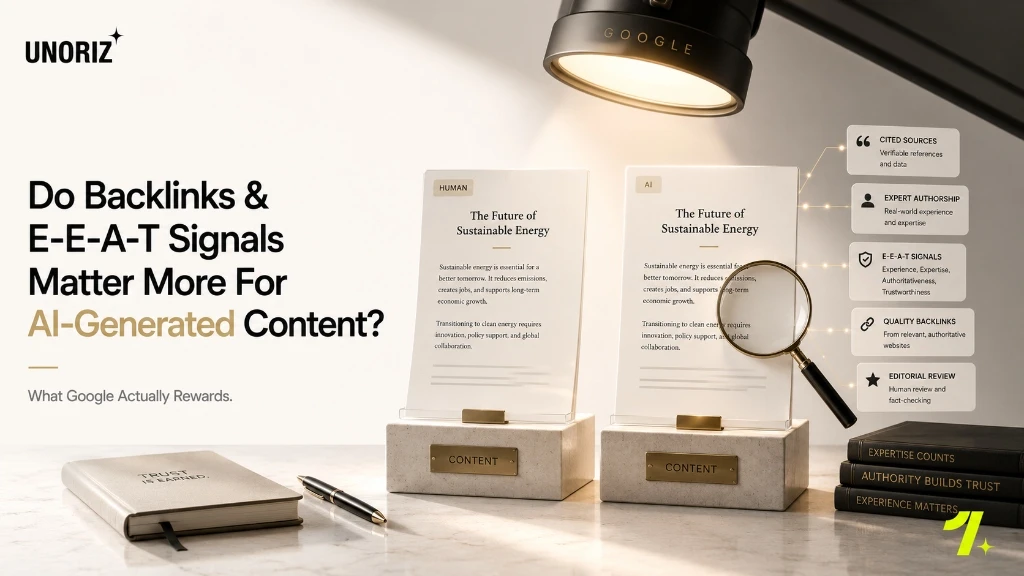
Google isn't running two separate rulebooks—one super strict for AI and one easy mode for humans. What's actually happening is that pure AI content, by default, shows up without the exact receipts that E-E-A-T (Experience, Expertise, Authoritativeness, and Trustworthiness) and backlinks are designed to reward. So it fails the exact same standard way more often. Let's break down why this gap happens and how to make sure your content actually clears the bar.
1. The Bar Is the Same, the Starting Point Isn't
E-E-A-T stands for Experience, Expertise, Authoritativeness, and Trustworthiness. It isn't a secret ranking score hidden inside Google's algorithms. It's the framework Google's human quality raters and search systems use to decide if a page deserves real trust. Backlinks work right alongside it as digital street cred: other reputable sites vouching for your content by linking to it.
Here's the real talk. Human-written content naturally packs higher experience and authoritativeness because it's born from actual lived insight. A reviewer who tested a product for 40 hours, a practitioner who solved 100 client cases, or an engineer who built a system has genuine receipts. AI on its own doesn't have a life. It can summarize facts and format text with chef's kiss organization, but without human input, it lacks firsthand experience to pull from.
The "bar" for what counts as trustworthy, authoritative content hasn't changed. What changed is that a huge chunk of AI content gets published without any human experience layer built in, which leaves it stranded at the baseline.
So when people ask if E-E-A-T and backlinks matter more for AI content, the answer is: they matter equally, but AI content starts with a zero balance on both fronts unless you actively inject human credibility back into the mix.
2. The Backlink Gap Is Real, and It's Big
If you think backlinks don't care about authorship, the numbers say otherwise. A 16-month study tracking thousands of published articles found that pure AI content earned 61% fewer editorial backlinks than human-written articles on the exact same topics. This deficit isn't random bad luck—it's basic human behavior online.
When writers, researchers, and creators read an article that brings fresh data or original perspectives, they link to it to give credit. When they read a re-hashed summary of things that already exist everywhere online—which is what unedited AI output usually is—they just scroll past. No clout, no links.
Pure AI articles earned 61% fewer editorial backlinks than human-written articles on the same keywords across a 16-month cohort study.
Ahrefs data across 600,000 pages found zero practical correlation between AI usage and ranking penalties when human oversight was present.
Backlinks remain a top-3 ranking factor in Google's core algorithm. Without organic links, AI content might score a quick indexing win, but it lacks the structural backlink foundation needed to survive core algorithm updates over time.
Here is the plot twist though: an extensive Ahrefs analysis covering over 600,000 web pages revealed that 86.5% of top-ranking pages already contain some AI-generated content, with a correlation between AI usage and ranking penalties hovering at basically zero (0.011). That proves AI isn't the problem—relying on AI without human editing and real author credibility is what gets you cooked.
3. AI Content Fails the Bar Fast Without Human Backup
The drop-off rate for unbacked AI content is brutal. Long-term ranking experiments show that only 3% of pure AI-generated pages stayed in the top 100 rankings after 3 months when they lacked authority or E-E-A-T signals. That means 97% of unedited AI pages faded into search engine oblivion.
This trust gap hits even harder in AI answer engines like Perplexity, ChatGPT Search, and Google AI Overviews. An audit of over 15,000 AI Overview results found that 96% of cited sources had strong E-E-A-T signals, leaving just a tiny 4% slice for everything else.
Ninety-seven percent of pure AI pages dropped out of the top 100 within 90 days when published without author credentials or backlinks.
Simply attaching real, verifiable author credentials and bios increases AI search citation probability by 60%.
Research also proves that content from recognized, credentialed experts gets cited three times more often than anonymous content, and adding a real author bio boosts citation probability by 60%. Publishing nameless AI articles in 2026 is an automatic self-sabotage—AI systems checking sources in real-time want verified human receipts before quoting you.
4. Why This Isn't the Whole Story
Let's keep it 100: AI content isn't worse at everything. Reader testing data reveals that AI-written drafts actually scored higher on readability (61%) than raw human-written ones (55%). AI is amazing at smoothing out awkward phrasing, organizing complex ideas, and making text super readable.
So AI content doesn't fail because it reads poorly; it fails because it lacks the deep trust infrastructure—backlinks, verified credentials, and real-world testing—that algorithms use to measure authority.
Plus, with zero-click searches driving over 58.5% of Google queries, user behavior is shifting toward AI search engines like Perplexity. That means pure backlink quantity is no longer the only game in town—whether AI models trust your author entity enough to extract and cite your answers is lowkey becoming just as vital.
5. What This Means for Your Content
The goal isn't to banish AI tools from your workflow. The play is giving your AI content a massive glow up by adding the trust layers only real humans can provide. Here is the playbook backed by current search data:
1. Ditch Anonymous Publishing
Always publish AI-assisted work under a named, credentialed author with a real bio and verified social handles. Author entity signals give AI engines the trust confidence they require.
2. Inject Original Firsthand Data
Add real screenshots, personal case studies, unique survey numbers, or expert quotes that LLMs cannot synthesize from existing web scrapes. This is where genuine Experience signals live.
3. Quality Backlinks Over Quantity
Prioritize acquiring editorial backlinks from high-authority niche sites rather than pumping out dozens of generic AI posts. One strong backlink beats ten unread AI articles every single time.
6. The Bottom Line
Do backlinks and E-E-A-T signals matter more for AI-generated content? In terms of search engine rules, no—the bar is identical for everyone. But in terms of outcome, absolute yes. AI content starts at ground zero for both trust and linkability.
When you treat AI as your draft generator and humans as your final editorial and trust layer, your content hits different. It clears the E-E-A-T bar, earns high-value backlinks, and stands out as the main character in both Google search and AI answer engines.
7. Sources
- Kozec: AI SEO Content Quality vs Human Written: 2026 Data
- Savit: AI Content vs Human Content in 2026: What Works Best?
- NAV43: Author Pages, E-E-A-T, and AI Search Visibility
- Digital Hothouse: E-E-A-T for AI: Building Trust Signals That Algorithms Actually Recognise
- Surfeo: E-E-A-T in the Age of AI Search: What Actually Matters
- Contently: AI Citations vs Backlinks: What Matters More in 2026
- TechRT: AI vs Human Content Statistics 2026
8. Frequently Asked Questions
Do backlinks matter more for AI-generated content than human content?
Is Google actually stricter with AI content than human content?
What happens to AI content that has no E-E-A-T signals attached?
Does adding an author bio actually help AI content get cited?
Do AI answer engines like ChatGPT and Perplexity care about E-E-A-T too?
Is AI-written content always lower quality than human content?
What's the single biggest fix for AI content struggling with E-E-A-T?
Topics & Tags

Rishabh Kumar
Author & Lead ResearcherFounder & AI Product Strategist
7+ years building digital products, AI workflows, and human optimization systems for 20+ global clients including Google, Samsung, and Microsoft.