Key Takeaways
- AI-assisted content (AI drafting with human editing) landed within 4% of fully human-written content on median Google ranking position in a 16-month study of 4,200 articles.
- Unedited AI-generated content ranked 23% lower on average and picked up 61% fewer editorial backlinks than human-written pieces targeting the same keyword.
- Position 1 results in Google Search are 80.5% human-written and only 10% AI-generated, proving heavy editing and original insight are required to win top rankings.
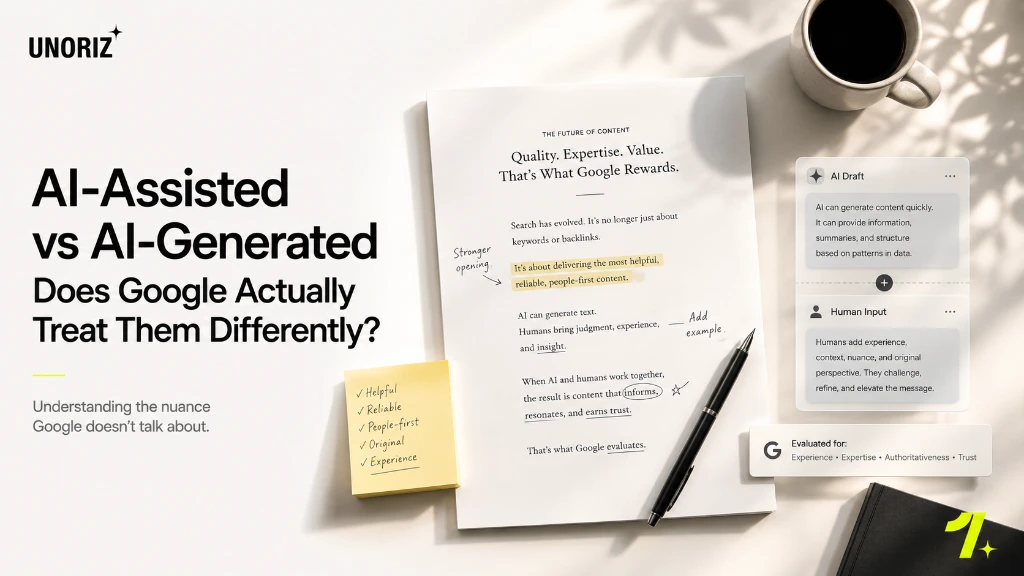
Yes, and the gap between the two is bigger than most people treat it. "AI wrote this" gets thrown around like it means one thing. It doesn't. There's a massive difference between a human using AI as a drafting tool and a human hitting publish on whatever the AI spit out. Google's own systems, and the ranking data, back that distinction up hard.
1. Google's Official Line, and Why It's Only Half the Story
Google has said the same thing since 2023: it doesn't care how content was made. It cares if the content is actually good. That's a real, documented position, not a myth. Google's spam policies specifically target "scaled content abuse," meaning mass-produced, low-effort pages, whether a human or a machine typed them.
But here's the catch nobody mentions enough. "Google doesn't care how content is produced" is technically true and also kind of misleading if you stop reading there. It's not saying AI content and human content perform the same. It's saying the method isn't the direct penalty trigger. The quality gap between AI-assisted and AI-generated content is what actually decides the outcome, and that gap is huge in the real data.
2. Two Very Different Things Wearing the Same Label
Let's actually define the terms, since most articles flatten them into one blob.
AI-Generated Content
AI produced the final output with little to no human involvement. Prompt goes in, article comes out, publish button gets clicked. No fact-check, no added expertise, no real editing pass.
AI-Assisted Content
A human used AI somewhere in the process—maybe for an outline, a first draft, or research—and then made real editorial decisions. Added expertise. Fact-checked claims. Rewrote weak sections. Shaped the final voice.
These two things can look identical on the surface. They perform nothing alike.
3. The Numbers That Prove the Split Is Real
A 16-month study tracking 4,200 articles across 140 domains and 12 industries, including health, finance, and SaaS, found pure AI content ranked 23% lower on average than human-written articles targeting the same keyword. That gap got worse after Google's core updates in March 2026, not better.
Now here's the part that actually matters for this whole debate. AI-assisted content, meaning AI-drafted work with real human editing, original data, and expert input layered on top, landed within 4% of fully human-written content on median ranking position. Four percent. That's basically a rounding error compared to the 23% gap for raw AI output. Same study, same tracking method, wildly different results depending on whether a human actually touched the draft before it went live.
AI content with human editing landed within 4% of human-written articles on median Google ranking position.
Pure, unedited AI output ranked 23% lower on average across 4,200 tracked articles in 12 industries.
Position 1 results were 80.5% likely to be human-written and only 10% likely to be AI-generated in 42,000 blog posts.
AI-only content picked up 61% fewer editorial backlinks than comparable human-written pieces.
The same research flagged something practical too. AI-only content picked up 61% fewer editorial backlinks than comparable human-written pieces. Since backlinks remain one of the strongest ranking signals Google uses, that's not a small side effect, that's a structural disadvantage baked into skipping the human layer.
Separately, Semrush's analysis of 42,000 blog posts found the split gets sharpest right at the very top. Position 1 results were 80.5% likely to be human-written and only 10% likely to be AI-generated. But AI-generated content showed up more often in positions 2 through 4, meaning it can absolutely make page one, it just rarely wins the top spot without heavy editing behind it.
Another 2026 analysis found only 17% of top-20 results were predominantly AI-generated, even though more than half of all online content today involves AI in some form. That's a wide gap between how much AI content exists and how much of it actually competes at the top.
4. Why the Gap Exists (It's Not Really About Detection)
Google isn't running some secret "AI detector" that flags and punishes pages. It has stated it doesn't use AI detection tools as a ranking signal, and honestly, public AI detectors are unreliable enough that leaning on them would be a mess anyway.
The real reason AI-generated content underperforms comes down to what's actually missing from it: original insight, specific data, firsthand experience, and a distinct point of view. Raw AI output tends to sound smooth and generic because it's built from patterns, not lived experience. Google's ranking systems, especially the Helpful Content System, are specifically built to reward pages that show real expertise and genuinely satisfy the reader, which is exactly the layer that human editing adds back in.
"So it's less 'Google penalizes AI' and more 'Google rewards depth, and raw AI drafts usually lack it until a human fixes that.'"
5. What This Actually Means for Your Workflow
The takeaway isn't "avoid AI." It's "don't skip the human part." A few things the data actually supports:
Industry Adoption Blueprint (64%)
Using AI to draft, outline, or speed up research is fine and increasingly standard—64% of SEO teams now run this exact human-led, AI-assisted model with great success.
- Use AI to speed up drafting: Use AI to draft, outline, or accelerate research, but always maintain a strict human editing layer.
- Add unique value: Always add something the AI couldn't generate on its own: original data, a real example, a specific number, an actual opinion.
- Rigorous fact-checking: Fact-check every claim before publishing. This step alone separates the content that ranks from the content that quietly gets buried.
- Avoid high-volume thin content: Watch for thin, high-volume publishing. Mass-producing AI drafts without review is the exact pattern Google's scaled content abuse policy targets, and it's what tanks the 61% backlink gap even further.
6. The Bottom Line
"AI wrote this" isn't one category, it's two, and Google's results treat them like it. AI-generated content with no human layer underperforms by a real, measurable margin, roughly 23% lower rankings and a much smaller shot at position 1. AI-assisted content with genuine human editing performs almost identically to fully human writing. The tool isn't the deciding factor here. The editing pass is.
7. Sources
- Google Search Central: Google Search's guidance about AI-generated content
- Digital Applied: AI vs Human Content: 16-Month Google Ranking Study
- Semrush: Does AI content rank well in search? Survey + Data study
- theStacc: Google AI Content Policy 2026
- HCube Web Solutions: AI vs Human Content: What Google Actually Wants in 2026
- Addlly: Can AI Content Rank On Google? The 2026 Data
8. Frequently Asked Questions
Does Google actually treat AI-assisted content differently from AI-generated content?
What's the actual difference between AI-assisted and AI-generated content?
Does Google use AI detectors to penalize content?
Can fully AI-generated content still rank on Google?
Why does unedited AI content get fewer backlinks?
What is Google's "scaled content abuse" policy?
What's the safest way to use AI for content without hurting rankings?
Topics & Tags

Rishabh Kumar
Author & Lead ResearcherFounder & AI Product Strategist
7+ years building digital products, AI workflows, and human optimization systems for 20+ global clients including Google, Samsung, and Microsoft.