Key Takeaways
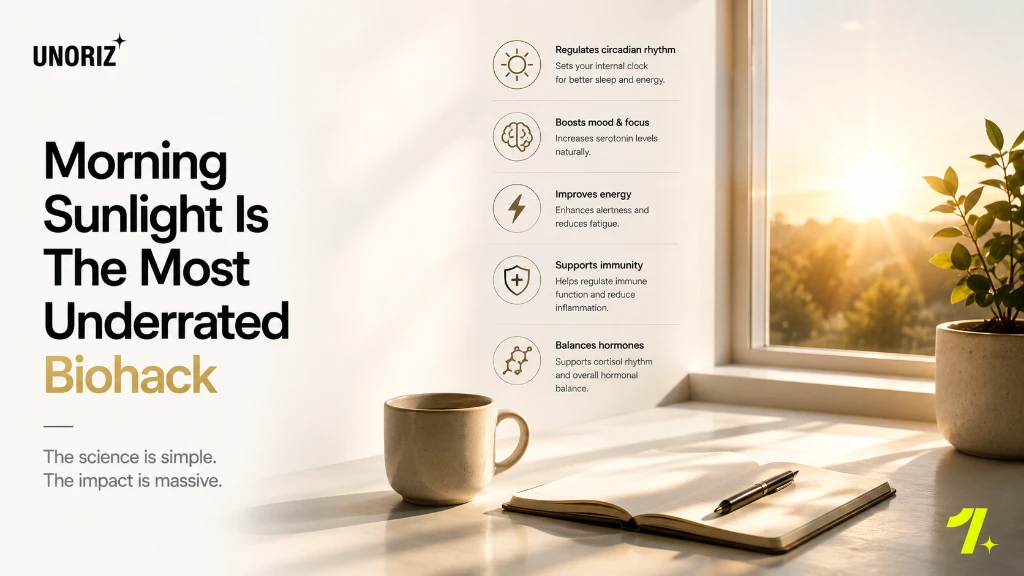
- The Melanopsin Photoreceptor Trigger: Morning outdoor light exposure (10,000–100,000 lux) within 30–60 minutes of waking stimulates intrinsically photosensitive retinal ganglion cells (ipRGCs), anchoring the cortisol awakening response (CAR) and setting a 14–16 hour neural timer for nocturnal melatonin onset.
- Thermal Gating of Slow-Wave Sleep: Initiating and sustaining deep non-REM restorative sleep requires a core body temperature drop of 1.0°C to 1.5°C, facilitated by ambient bedroom cooling (18°C / 65°F) and peripheral vasodilation.
- Adenosine Clearance Before Caffeine: Delaying caffeine consumption by 90–120 minutes post-waking allows residual nocturnal adenosine to clear naturally via the glymphatic and enzymatic pathways, preventing the 2:00 PM receptor rebound crash.
Human cognitive energy is not a flat battery that drains linearly from morning to night. It is an oscillating biological wave governed by a cluster of roughly 20,000 neurons in the anterior hypothalamus known as the Suprachiasmatic Nucleus (SCN).
When your light environment, meal timing, and thermal exposure drift out of phase with this master pacemaker, your body experiences circadian misalignment — the same neuroendocrine disruption as chronic jet lag without ever boarding a plane. Conversely, when you architect your day around three primary zeitgebers (time-givers) — light intensity, temperature gradients, and feeding windows — daytime executive focus sharpens and nighttime deep sleep consolidates automatically.
1. The Master Clock: Suprachiasmatic Nucleus (SCN)
Nearly every nucleated cell in the human body contains autonomous molecular clock genes (such as CLOCK, BMAL1, PER, and CRY) operating on an approximate 24-hour transcriptional-translational feedback loop — discoveries honored by the 2017 Nobel Prize in Physiology or Medicine (Hall, Rosbash & Young, 2017). Left in isolation, however, these peripheral clocks in the liver, heart, and prefrontal cortex rapidly desynchronize.
The SCN acts as the central conductor that keeps every organ synchronized to solar time. It receives direct photic input from a specialized class of non-image-forming photoreceptors in the lower retina: melanopsin-expressing intrinsically photosensitive retinal ganglion cells (ipRGCs). When high-intensity short-wavelength photons strike these receptors in the morning, the SCN fires a neural signal along the retinohypothalamic tract, triggering the healthy morning cortisol pulse while suppressing pineal melatonin synthesis (Panda, Salk Institute, 2026).
Controlled photobiology trials demonstrate that bright outdoor light exposure (10,000+ lux) shortly after waking elevates the morning cortisol awakening pulse by roughly 50%, enhancing daytime vigilance and advancing nocturnal sleep onset.
2. The 3-Step Morning Photic & Neurochemical Protocol
Most knowledge workers wake up and immediately look at a smartphone screen indoors (roughly 100–300 lux) while drinking coffee on an empty stomach. That sequence fails to trigger the melanopsin threshold and traps residual adenosine in the brain. Instead, apply this three-part activation sequence:
- Unfiltered Outdoor Sunlight Within 30–60 Minutes of Waking: Step outside for 10 minutes on a clear morning (or 20–30 minutes under cloud cover). Even an overcast sky delivers 10,000 to 25,000 lux — orders of magnitude higher than indoor LED lighting — and window glass filters out up to 50% of the relevant circadian wavelengths.
- The 90-Minute Caffeine Delay: Caffeine is a competitive adenosine-receptor antagonist; it blocks $A_1$ and $A_{2A}$ receptors without clearing adenosine itself. Waiting 90 minutes allows the morning cortisol peak and physical movement to clear residual sleep-pressure adenosine first, eliminating the afternoon rebound crash when caffeine metabolizes.
- Morning Thermal & Locomotor Rise: Brief aerobic movement or deliberate cold water exposure in the morning accelerates the natural rise in core body temperature, increasing dopamine and norepinephrine tone for sustained 3–4 hour deep-work blocks.
3. Core Thermal Dynamics & Slow-Wave Sleep Modulation
Just as a rising core body temperature signals wakefulness, a falling core temperature is the physiological gatekeeper of sleep onset. To enter and maintain slow-wave (Stage N3) deep sleep, your brain and internal organs must dump heat through the glabrous skin palms, soles of the feet, and face — lowering core temperature by approximately 1.0°C to 1.5°C (2°F to 3°F) (Walker, UC Berkeley, 2026).
Counterintuitively, taking a warm bath or shower (40°C–42.5°C) for 10–15 minutes roughly 90 minutes before bedtime accelerates this cooling process. A systematic meta-analysis of 5,322 studies by biomedical engineers at the University of Texas at Austin found that passive body heating 1–2 hours before bed dilates peripheral blood vessels, rapidly dissipating core heat once you step into a cool bedroom (18°C / 65°F) and reducing sleep onset latency by 36% (Haghayegh et al., Sleep Medicine Reviews).
Triggering peripheral vasodilation via a warm bath 90 minutes pre-bed combined with an 18°C (65°F) sleeping environment accelerates core heat dissipation, shortening sleep latency by 36% and increasing deep slow-wave sleep density.
4. Nutrient Timing & Evening Down-Regulation
Your liver and pancreas run on peripheral clocks synchronized by food intake (Time-Restricted Eating). Consuming heavy meals within 3 hours of sleep forces digestive thermogenesis right when core body temperature needs to drop, while elevated nocturnal insulin blunts the first slow-wave sleep pulse of growth hormone (Panda, Salk Institute, 2026).
In the final 2 hours before sleep, dim overhead lighting below 30 lux (ideally warm amber lamps placed below eye level, where melanopsin ipRGCs are least sensitive). If targeted nutritional support is desired after behavioral foundations are locked in, clinical literature supports non-hormonal GABAergic cofactors — such as Magnesium L-Threonate or Magnesium Bisglycinate (145–200mg elemental), L-Theanine (100–200mg), and Apigenin (50mg) — over habitual high-dose exogenous melatonin, which can desensitize receptors and cause morning grogginess.
Ceasing caloric intake 3 hours prior to sleep eliminates digestive thermogenesis during the nocturnal core-cooling window, lowers resting nocturnal heart rate, and improves heart-rate variability (HRV) recovery scores.
5. References
- Nobel Assembly at Karolinska Institutet (Hall, Rosbash & Young): Molecular Mechanisms Controlling the Circadian Rhythm
- Salk Institute for Biological Studies (Dr. Satchin Panda): The Circadian Code: Melanopsin Photoreception and Time-Restricted Feeding
- Sleep Medicine Reviews (Haghayegh et al.): Before-Bedtime Passive Body Heating by Warm Shower or Bath to Improve Sleep: A Systematic Review and Meta-Analysis
- Center for Human Sleep Science, UC Berkeley (Dr. Matthew Walker): Thermal Regulation, Slow-Wave Sleep Architecture, and Adenosine Pharmacology
- Journal of Clinical Endocrinology & Metabolism: Exposure to Room Light Before Bedtime Suppresses Melatonin Onset and Shortens Melatonin Duration in Humans
6. FAQs
1. Does looking at morning sunlight through a window count for circadian alignment?
2. Why does delaying morning coffee by 90 minutes prevent an afternoon crash?
3. How does a hot shower before bed cool the body down?
4. What should I do if I wake up before sunrise in winter?
5. Why does late-night eating disrupt deep sleep even if I fall asleep easily?
Topics & tags

Rishabh Kumar
Author & Lead ResearcherFounder & AI Product Strategist
7+ years building digital products, AI workflows, and human optimization systems for 20+ global clients including Google, Samsung, and Microsoft.