Key Takeaways
- Gutenberg's 1400s printing press sparked the exact same moral panic as AI today, with abbots arguing mass printing would make humans intellectually lazy and flimsy.
- The printing press didn't kill handmade craft—it split the market in two: mass production took the fast-and-cheap lane, while human craft moved into meaning, ritual, and high-status value.
- Current 2026 economic data confirms this split: 73% of consumers pay a premium for human-made goods, while apps labeled "AI-powered" suffer a 25% "algorithm discount".
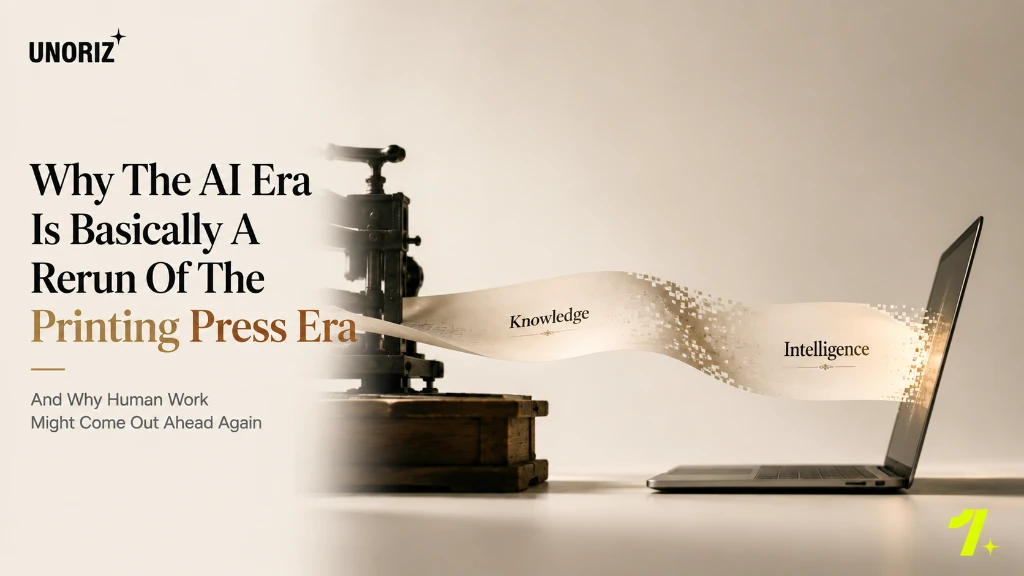
Everyone's convinced AI is about to make human creativity pointless. Same content, faster, cheaper, infinite. It sounds like the end of the story. But we've actually run this exact experiment before, almost 600 years ago, and it did not go the way people expected.
1. The Original “Machines Are Taking Over” Panic
Before Johannes Gutenberg's printing press, books were made by scribes, monks who spent months, sometimes up to a year, hand-copying a single Bible letter by letter. It was slow, expensive, and only the wealthy or the church could afford it. Then the printing press showed up in the 1400s and mass production entered the picture. Books that took a year to copy could now be printed by the hundreds in weeks.
Scribes panicked, and honestly, fair enough. A German abbot named Johannes Trithemius wrote an entire book in 1492 called “In Praise of Scribes,” arguing that hand-copying sacred texts was a spiritual practice and that printed books were flimsy, soulless, and would make monks intellectually lazy. He even claimed printed books wouldn't last, so monks should keep hand-copying important texts just to preserve them properly. It reads exactly like a 2026 op-ed about AI, just with quills instead of prompts.
The scribes weren't wrong that things were about to change massively. They were wrong about what would happen to the value of human-made work.
Abbot Trithemius published “In Praise of Scribes” claiming machine prints were soulless—a 530-year-old precursor to the exact psychological debate surrounding AI automation today.
2. What Actually Happened Next
Handwritten manuscripts didn't disappear. Calligraphy took a hit for a while, sure, mass printing did reduce everyday demand for hand-copied documents. But it didn't stay down.
By the late 1800s, calligraphy experienced a full revival led by the British artist William Morris, who got obsessed with old scribe techniques, started illuminating manuscripts by hand again, and eventually founded his own press specifically to celebrate the craft of handmade books. His work directly inspired the founding of the Society of Scribes and Illuminators in 1921, a professional guild built entirely around preserving hand lettering as an art form, decades after printing had already won the mass-production war.
Here's the pattern worth sitting with: printing didn't erase handmade craft. It split the market in two. Mass production took over the “just get me information fast and cheap” lane. Handmade work moved into a completely different lane: meaning, ritual, status, and beauty. Diplomas, certificates, and legal documents still use calligraphy today, not because it's efficient, but because it signals something machine printing can't.
3. The Same Thing Is Happening Right Now, With Data to Prove It
Fast forward to 2026, and the exact same split is showing up in industries that have nothing to do with books.
Vinyl records just hit their 19th straight year of growth, crossing $1 billion in US revenue in 2025 for the first time since 1983, even while music streaming keeps growing too. The average vinyl price has risen 24% since 2020, and it hasn't slowed demand at all. And this isn't a nostalgia thing for older listeners. 76% of Gen Z buyers purchase vinyl at least monthly, and most own a turntable. People aren't choosing vinyl because it's convenient. They're choosing it because it feels real.
The global handmade and craft economy is projected to hit $1.34 trillion in 2026, growing over 10% a year. That's not a rounding error next to any AI market forecast.
The global craft economy continues 10%+ annual growth, while 73% of consumers explicitly report a willingness to pay higher prices for human-crafted creations over AI outputs.
And people are now paying real, measured premiums specifically for “human-made” over AI-made. A 2026 study found that 73% of people said they'd pay more for something made by a human than something made by AI, even when both looked equally good. A separate real-world pricing test found that simply calling an identical app “AI-powered” instead of leaving that detail out dropped what people were willing to pay by 25%.
Researchers are calling this the “algorithm discount,” basically a markdown that shows up the second people learn AI was involved, regardless of actual quality.
Lab pricing tests reveal that branding an identical digital tool as “AI-powered” slashes consumer willingness to pay by a full quarter, regardless of utility.
Even in fine art, where AI-generated pieces have genuinely gotten impressive, collectors are doing something researchers call the “human premium.” A Columbia Business School study found people didn't rate AI art lower on skill, but rated it noticeably lower on creativity and perceived effort, and were willing to pay less for it purely because of that authorship gap.
4. Why This Keeps Happening
It's not really about quality. It's about what humans actually value the thing for. When something is scarce, effortful, and made by a specific person, it carries meaning beyond its function. Mass production is incredible at solving “I need this fast and cheap.” It has never been good at solving “I want to feel connected to who made this.” That second need doesn't go away when a new technology shows up. If anything, it gets stronger, because it becomes rarer and therefore more valuable.
The printing press didn't kill meaning. It just moved meaning to a smaller, more intentional lane, and that lane became more valuable, not less, once the panic wore off.
5. The Bottom Line
Every “machines are about to make humans redundant” moment in history has followed roughly the same arc: mass panic, real disruption to the old way of doing things, and then a market correction where human-made work becomes more prized, not less, specifically because it's no longer the default.
The printing press proved this with scribes and calligraphy. Vinyl and the modern “human premium” are proving it again right now, in real time, with actual receipts. AI isn't likely to be the exception. History's already run this exact test, and human work won last time too.
6. Sources
- SMS Online: How the Printing Press Reshaped Associations
- Britannica: Calligraphy, Revival 19th-20th Centuries
- Keep Them Spinning: Vinyl Records Statistics 2026
- ArtHelper: 2026 Arts & Crafts Industry Trends
- ArabAd: Why “Made by a Human” Is Turning Into a Price Tag
- Columbia Business School: Beyond the Machine: Why Human-Made Art Matters More in the Age of AI
7. Frequently Asked Questions
1. Did the printing press actually threaten scribes the way people think AI threatens creators today?
2. Did handmade calligraphy disappear after the printing press took over?
3. Is there real data showing people pay more for human-made content or products today?
4. Is the vinyl record comeback actually connected to AI backlash?
5. Do people think AI-generated art is lower quality than human art?
6. Is the handmade and craft economy actually growing, or is it a niche market?
7. Does this mean AI content and human content can coexist rather than compete directly?
Topics & Tags

Rishabh Kumar
Author & Lead ResearcherFounder & AI Product Strategist
7+ years building digital products, AI workflows, and human optimization systems for 20+ global clients including Google, Samsung, and Microsoft.